
Anti-Kallikrein-4 Rabbit Polyclonal Antibody
- Host
- Rabbit, Polyclonal
- Reactivity
- Validated- Human Potential-Pan, Monkey, Dog, Pig
- UniProt
- Q9Y5K2
- Size
- 100ug
- Cat. #
- RP2Kallikrein4
In stock
- SKU
- RP-Kallikrein4
Target Overview
Kallikrein-4 (KLK4, UniProt Q9Y5K2) is a secreted serine protease (EC 3.4.21.-) belonging to the kallikrein family, with a primary role in dental enamel maturation. Also known as enamel matrix serine proteinase 1 (EMSP1), prostase, or serine protease 17, KLK4 is expressed during the maturation stage of tooth development, where it degrades residual enamel matrix proteins to permit proper mineralization and crystalline organization. The 254-amino acid enzyme is secreted by ameloblasts and is essential for clearance of amelogenin and other enamel proteins from the developing enamel matrix. Loss-of-function mutations in KLK4 result in amelogenesis imperfecta, characterized by hypomineralized, discolored, and structurally defective enamel. Beyond odontogenesis, KLK4 has been detected in prostate tissue and other sites, though its physiological role outside enamel formation remains less well defined. Researchers studying enamel development, amelogenesis imperfecta, and serine protease biology rely on KLK4 detection to assess protease expression, localization, and activity in mineralized tissue contexts.
Background
References
- Singh A et al (2025) Comparative Proteomic Profiling of Enamel of Neonatal Teeth and Normal Primary Teeth Using Liquid Chromatography-Mass Spectrometry Approach. Pediatr Dent. PubMed
- Yamashita S et al (2026) Developmental vulnerability to fluoride toxicity: enamel and clearance differences in adolescent versus mature mice. Arch Toxicol. PubMed · DOI
- Gorbunova IL et al (2025) [Analysis of the content of some chemical trace elements in intact tooth enamel of individuals with different frequency of polymorphisms of the kallikrein-4 gene]. Stomatologiia (Mosk). PubMed · DOI
- Aydin EB et al (2025) Highly sensitive and selective detection of KLK4 in human serum with a low-cost electrochemical biosensor. Turk J Chem. PubMed · DOI
Additional Specifications
| Gene Symbol | KLK4 |
|---|---|
| UniProt ID | Q9Y5K2 |
| Host Species | Rabbit |
| Species Reactivity | Validated- Human Potential-Pan, Monkey, Dog, Pig |
| Pack Size | 100ug |
| Immunogen (Kallikrein loop) | Immunogen is proprietary and confidential. Immunogen generated in amino acid region 70-90. |
| Immunogen (Catalytic domain) | Immunogen is proprietary and confidential. Immunogen generated in amino acid region 31-254. |
| Alternate Names | KLK4, Kallikrein-4, Enamel matrix serine proteinase 1, EMSP1, Kallikrein-like protein 1, KLK-L1, Prostase, Serine protease 17, EC 3.4.21.- |
Frequently Asked Questions
What molecular weight should I expect for Kallikrein-4 on Western blot?
Kallikrein-4 has a predicted molecular weight of approximately 28 kDa based on its 254-amino acid sequence. However, the protein is synthesized as a preproenzyme with a signal peptide that is cleaved during secretion, so the mature, active form typically migrates around 25-27 kDa. In some tissue lysates, particularly from prostate or dental tissue, you may observe bands near 30 kDa representing the pro-form. Post-translational modifications including glycosylation have been reported in certain contexts, which can shift apparent molecular weight. Always include a positive control lysate from KLK4-expressing tissue to confirm the expected pattern.
What is the recommended starting dilution for this Kallikrein-4 antibody in Western blot?
We recommend starting at 1:1000 dilution for Western blot applications with this rabbit polyclonal antibody. This dilution has been validated with standard chemiluminescent detection systems. If your sample has low KLK4 expression or you are working with secreted fractions where the protease may be dilute, you may need to increase antibody concentration to 1:500. Conversely, for overexpression lysates or recombinant protein, 1:2000 may provide cleaner signal. Titrate against your specific lysate type, as ameloblast-derived samples will have substantially higher KLK4 than most other tissue sources.
Does this antibody cross-react with other kallikrein family members?
Kallikrein-4 shares sequence homology with fourteen other human kallikrein proteases, particularly KLK5, KLK6, and KLK7. This polyclonal was raised against a relatively selective epitope region to minimize cross-reactivity, but kallikrein family members can co-migrate near 25-30 kDa on Western blots. For samples with multiple kallikreins present, such as prostate or skin tissue, consider running a KLK4 knockout or knockdown lysate as a specificity control. The antibody has been validated against recombinant KLK4 and in tissues where KLK4 is the predominant kallikrein, such as maturation-stage dental epithelium.
Which species can I use this Kallikrein-4 antibody with?
This antibody is validated for human KLK4 detection. Cross-reactivity with monkey, dog, and pig is predicted based on epitope sequence conservation but has not been experimentally confirmed in-house. If you are working with rodent samples, note that mouse and rat KLK4 orthologs show lower sequence identity in several epitope regions, and we cannot guarantee reliable detection. For non-human work, we recommend confirming specificity by including a lysate spike with recombinant human KLK4 or running parallel samples from a validated human source to benchmark signal intensity and band pattern.
What sample types and lysis conditions work best for detecting Kallikrein-4?
Because KLK4 is a secreted serine protease, it is enriched in conditioned media, saliva, and extracellular fractions rather than whole-cell lysates. For tissue samples, ameloblast-rich dental organ extracts during enamel maturation are ideal positive controls. Prostate tissue and seminal plasma also contain detectable KLK4. Use standard RIPA or NP-40 lysis buffers; avoid reducing agents during sample preparation if you need to preserve disulfide-dependent epitopes, though this antibody typically performs well under standard reducing SDS-PAGE conditions. Store lysates at -80°C and minimize freeze-thaw cycles, as proteolytic activity can degrade target.
Can this antibody detect both pro-KLK4 and the active mature form?
This polyclonal antibody recognizes epitopes present in both the pro-enzyme and mature active forms of Kallikrein-4. The pro-form includes an N-terminal activation peptide that is cleaved by trypsin-like proteases to generate the active enzyme. Depending on tissue context and processing state, you may see a doublet or two distinct bands on Western blot corresponding to these forms. In ameloblast secretions or extracellular samples with active proteolytic processing, the mature form typically predominates. If distinguishing activation state is critical to your experiment, consider running samples with and without exogenous protease inhibitors to assess cleavage.
What are the proper storage conditions for this Kallikrein-4 antibody?
Store the antibody at -20°C in the supplied glycerol-containing buffer. Avoid repeated freeze-thaw cycles, which can reduce antibody titre and increase background. For routine use, we recommend preparing single-use aliquots immediately upon receipt: thaw the stock once, dispense 10-20 µL volumes, and refreeze. Working aliquots diluted in blocking buffer with 0.02 percent sodium azide can be stored at 4°C for up to one week, though fresh dilutions generally provide more consistent signal. Do not store diluted antibody long-term or expose the stock vial to temperatures above 4°C for extended periods.
What positive and negative controls should I use when validating Kallikrein-4 detection?
For positive controls, recombinant human KLK4 protein is ideal if available. Biologically, maturation-stage ameloblast lysates or conditioned media from ameloblast cell lines provide robust signal. Prostate tissue lysates or LNCaP prostate cancer cell lysates are more accessible alternatives, though KLK4 expression is lower than in dental tissue. Negative controls should include tissues with minimal or absent KLK4 expression, such as liver, skeletal muscle, or lymphocytes. Knockout cell lines or siRNA-treated samples targeting KLK4 serve as specificity controls to confirm observed bands are not from cross-reactive kallikreins or non-specific binding.
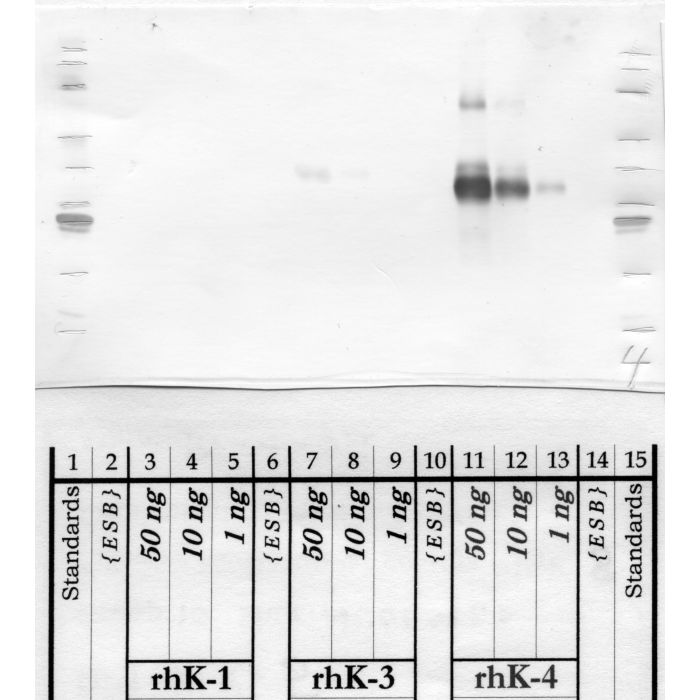
Western blot validation for RP-Kallikrein4 — 2 panels across the domain-specific antibody variants. Each blot below shows the clone that validates a specific domain of the target protein.


Custom validation studies available on request — contact us.
Also known as:
- KLK4
- Kallikrein-4
- Enamel matrix serine proteinase 1
- EMSP1
- Kallikrein-like protein 1
- KLK-L1
- Prostase
- Serine protease 17
- EC 3.4.21.-